When to Add More Sets

You should add more sets when a muscle is recovering well, your technique is still solid, and progress has slowed despite consistent training. Add only 1 to 2 hard sets per muscle per week, then watch performance for two or three weeks before adding more.
More sets can help build muscle, but only when they add useful stimulus. If the extra work makes your reps drop, your joints ache, or your next workout worse, it is not productive volume. It is just more fatigue.
The practical question is not “Can I survive another set?” It is “Will this set make next week better?”
What Counts as Adding Volume
Training volume usually means the number of hard working sets you do for a muscle each week. A hard set is a set taken close enough to failure to count as real training, usually within about 0 to 4 reps in reserve.
So adding volume might mean:
- Adding one set to an exercise you already do
- Adding one extra exercise for a lagging muscle
- Adding a second weekly exposure for a muscle you only train once
- Adding a back-off set after a heavy top set
It does not mean counting warm-ups, technique practice, or random low-effort sets just because they appear in the workout. If the set is not challenging, it does not solve a volume problem.
The Best Time to Add Sets
Add sets when three things are true at the same time.
First, the target muscle is not progressing. Maybe your reps have stayed flat for several weeks, the pump and connection feel muted, or a muscle is clearly lagging behind the rest of your program.
Second, you are recovering well. Soreness is manageable, sleep is normal, joints feel fine, and the next session for that muscle does not feel worse than the last one.
Third, your current work is already good. Your form is consistent, your range of motion is honest, and your hard sets are not rushed or sloppy.
If all three are true, adding a small amount of volume is reasonable. If one of them is missing, solve that first.
Do Not Add Sets Just Because a Workout Felt Short
A short workout can still be complete. A long workout can still be poorly designed.
The easiest way to overdo volume is to treat time in the gym as proof of effort. You finish your planned work, feel like you could do more, and add a few extra sets because leaving feels too easy. That might be fine once in a while, but it becomes a problem when extra work turns into the default.
Before adding a set, ask:
- Which muscle needs more work?
- What evidence says it needs more?
- Will this set still be high quality?
- Can I recover from it before the next session?
If you cannot answer those questions, the extra set is probably there to make the workout feel harder, not better.
 Extra work should be a planned dose, not a reflex at the end of a session.
Add Sets by Muscle, Not by Exercise Count
Most lifters think in exercises: one more chest exercise, one more curl, one more leg movement. That can work, but it is imprecise.
Think by muscle instead. If your chest is stuck, adding another pressing set and another fly set are not the same decision. One may add useful chest volume with more triceps and shoulder fatigue. The other may isolate the target better but add less load. If your quads need work, an extra squat set and an extra leg extension set have different recovery costs.
This matters because muscles do not recover at the same rate. Your side delts may tolerate more weekly sets than your hamstrings. Your calves may need frequency. Your lower back may limit how much extra rowing or hinging you can add before the target muscles are actually the ones holding you back.
If you want a baseline, start with the broader weekly target in how many sets per muscle group per week, then adjust one muscle at a time.
A Simple Rule: Add 1 to 2 Sets Per Week
The safest increase is small enough that you can judge it clearly.
Use this sequence:
- Pick one muscle that needs more work.
- Add 1 to 2 hard sets per week for that muscle.
- Keep the rest of the program the same.
- Run that change for 2 to 3 weeks.
- Keep it only if performance, recovery, or muscle feel improves.
That is enough to learn something. If you add six sets across three different muscles in one week, you will not know what helped and what hurt.
For example, if your back has stalled at 10 weekly sets, move to 12. Add one set to rows on upper day and one set to pulldowns later in the week. If your reps stay stable and the target muscles feel better trained, keep it. If your elbows or lower back start complaining, the added volume may not be the right kind.
Where to Put the Extra Set
The best place for an extra set is usually where quality is still high.
Good options:
- Add one set to your first or second main movement, if technique stays clean
- Add one isolation set for a muscle that needs more direct work
- Add a back-off set after a top set, using a lighter load and controlled reps
- Add the set on a different day if the single-session workload is already high
Poor options:
- Adding a set after performance has already crashed
- Adding heavy compound work when the limiting factor is joint fatigue
- Adding another similar exercise that trains the same pattern with no new benefit
- Adding sets to every workout at once
If the extra set is ugly, rushed, or mostly done because you feel guilty, cut it.
How to Track This in Steady
Steady is useful here because it keeps volume visible by muscle instead of making you reconstruct it from memory. The Muscle Activation view shows planned and past weekly sets, so you can see whether a muscle is undertrained, in range, or already getting plenty of work before you add more.
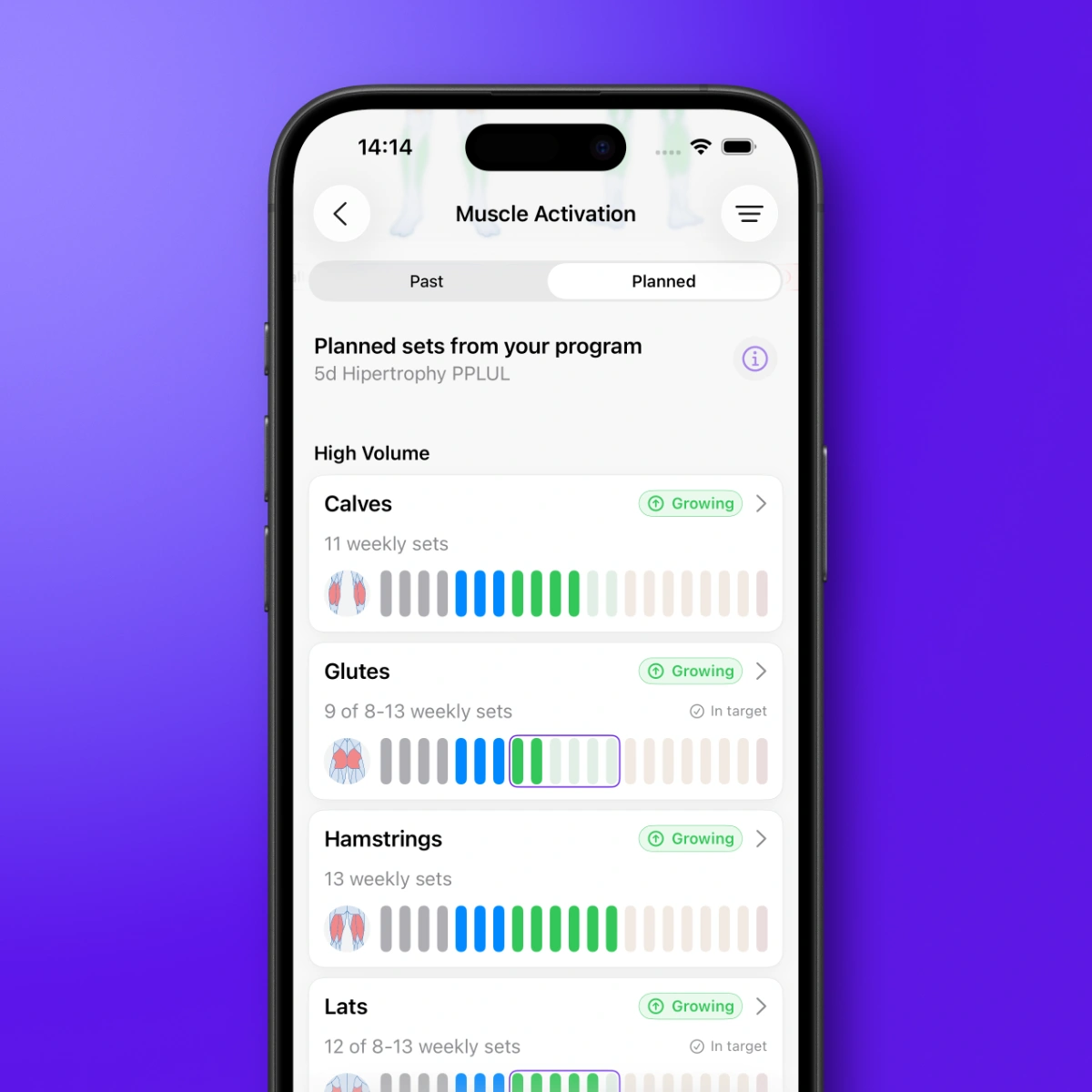 Use weekly set totals as a reality check before adding more work to a muscle.
That matters because extra sets often hide inside a program. One added chest set on Monday and one extra shoulder set on Thursday may look harmless in isolation. Across the week, they may push pressing volume high while your back or hamstrings still need attention.
Use the numbers as a guardrail. If a muscle is below target and recovery is good, add a small dose. If it is already high, focus on making the existing sets better before chasing more.
Signs the Extra Sets Are Working
Keep the added volume when you see several of these signs:
- Reps or load start moving again
- The target muscle feels better trained without joint irritation
- You recover before the next session
- Your form stays consistent across the new set
- Motivation stays steady because sessions still feel repeatable
The extra work does not need to produce a dramatic jump. A small improvement in reps, control, or consistency is enough evidence to keep testing.
Signs You Added Too Much
Pull back if the change creates these patterns:
- Reps drop sharply on later sets
- The next session gets worse for the same muscle
- Soreness lingers longer than normal
- Elbows, knees, shoulders, or lower back start feeling beat up
- You begin cutting range of motion to finish the work
Sharp, worsening, or persistent pain is different from ordinary training fatigue. Stop the movement and get guidance from a qualified clinician before trying to train through it.
That is the line where productive volume can turn into junk volume. The fix is not always a full deload, but it usually means removing the new sets and letting performance stabilize.
The Bottom Line
Add more sets when progress has slowed, recovery is good, and your current training quality is already solid. Start with 1 to 2 extra hard sets per muscle per week, keep everything else stable, and judge the result over a few weeks.
The best lifters do not add work randomly. They add the smallest useful dose, track what happens, and keep the sets that earn their place. Steady makes that easier by keeping your weekly volume visible, so the decision becomes based on evidence instead of gym-floor guesswork.
Ready to start applying progressive overload?
Ditch the spreadsheets and complex notes. Join thousands of lifters who use Steady to focus on the workout, track their progress, and automatically know when to add weight.
Download Free for iPhone