Forgot to End Your Workout? What to Do

If you forgot to end your workout, do not automatically discard it or leave it running. First ask one question: did the logged sets represent a real session you want in your history? If they did, finish the workout at a sensible end time. If you still intend to train, resume it. If it was an accidental start or the log is not worth keeping, discard it and begin cleanly later.
For most lifters, an open workout is not a training emergency. It is an admin detail worth resolving before it turns one clear session into confusing history, inflated duration, or a bad comparison next week.
Why an unfinished workout is worth fixing
An active workout usually carries more than a running clock. It contains the sets you completed, the point where you stopped, and the context your next session will use.
Leaving it open can make a 55-minute session look like a six-hour one. That can distort average workout duration and make you second-guess a future plan. More importantly, it creates uncertainty: did you finish that final exercise, stop midway through, or simply forget to tap the last button while packing your bag?
Resolve the session while the details are still fresh. The correct choice is usually simple once you separate the three situations below.
Finish it when the workout was really over
Choose Finish when you completed the training you meant to do—or when you deliberately stopped and want the work you did complete to count.
This is the right call when:
- you left the gym and only noticed later that the workout was still open;
- you completed the main work but skipped a small accessory exercise because time ran out;
- you ended early for a sensible reason, such as low energy, pain, or an equipment problem;
- every set in the log is real and useful context for the next session.
Finishing does not claim the workout was perfect. It says the record is honest. If you did two of three planned exercises, that is still better data than a fictional full session or a vanished one. A short note can preserve the reason you stopped if it will matter next time.
 Closing out a session while its details are clear keeps the next workout easier to interpret.
Resume it only when more training is actually coming
Choose Resume when the session genuinely continues. Maybe you had to leave for a short interruption, your phone died, or you are returning to finish the remaining work the same day.
Do not resume just because you feel guilty about an unfinished plan. A delayed, tired attempt to add one last movement can be less useful than ending the session honestly and returning to the program next time. If the interruption changed the point of the workout, finishing what happened is usually the cleaner choice.
There is also a practical limit: the longer the gap, the less one continuous workout describes what happened. If you trained in the morning and think about reopening it after dinner, treat that as a fresh decision rather than forcing two unrelated efforts into one record.
Discard it when the log should not exist
Choose Discard when the active workout is a false start or does not describe meaningful training. Common examples include opening the wrong routine by accident, tapping Start before changing your mind, or logging test entries you do not want in your history.
Discarding is not the answer to a merely imperfect workout. A real session with fewer sets, lower loads, or an early finish is still useful evidence. Keeping those records helps you spot the difference between a one-off rough day and a trend that needs a change.
If you are tempted to discard because a session felt bad, read Should You Delete Bad Workouts From Your Log? before you erase the context.
How Workout Recovery works in Steady
Steady’s Workout Recovery is designed for the moment you return after a workout was left open. After six hours of inactivity, the app presents a clear Workout Left Open choice: Finish Workout, Resume Workout, or Discard Workout. It uses your last completed set to suggest an end time, so closing the session does not have to pretend you trained until the moment you reopened the app.
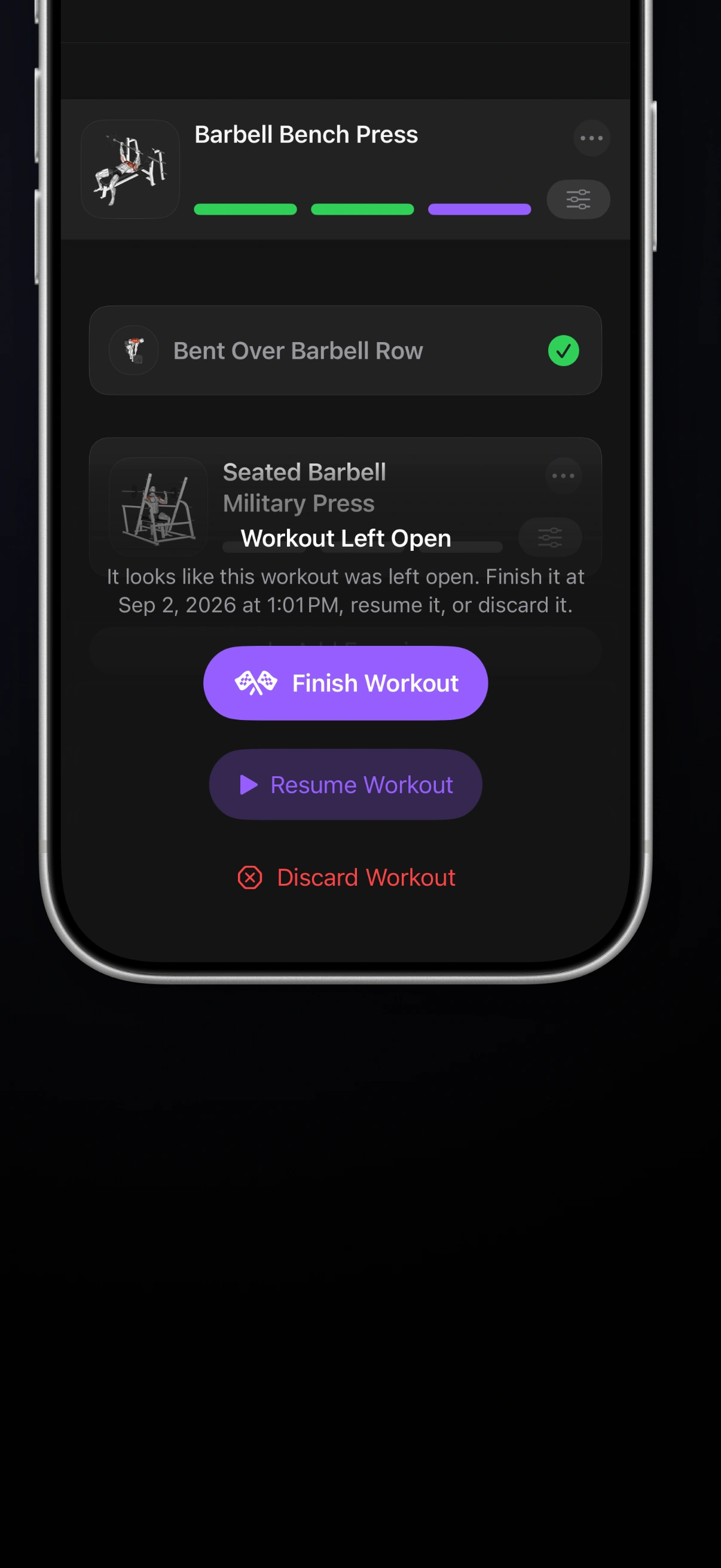 The recovery screen keeps the decision focused: preserve a real session, continue it, or remove a false start.
The feature is a recovery step, not a substitute for ending workouts normally. It appears when you come back to Steady after the inactive period, and it is intentionally narrow: decide what happened to this session before starting another one.
There is a related optional feature for catching the problem earlier: enable Finish Workout Reminder in Steady’s reminders settings. If Steady detects that you may have left a mostly completed workout running, it can send a notification reminding you to finish it. The reminder does not decide the outcome for you—it brings you back to the same deliberate choice of finishing, resuming, or discarding the session. It is especially useful if packing up, chatting after a session, or switching devices is where you usually lose the final step.
Make the next session easier to read
A good workout log does not need to be flawless; it needs to be interpretable. Before you close an accidentally open session, keep these rules in mind:
- Keep real work. Completed sets are useful even when the workout did not go to plan.
- Do not pad the record. Finish early rather than adding imaginary exercises or durations.
- Use one short note when needed. “Left after the second exercise—time ran out” is enough context.
- Restart cleanly when the next effort is separate. A new day or a long break deserves a new workout.
The same principle applies whenever training gets messy: record what happened, then make the smallest useful decision for next time. How to Adjust a Workout on Low-Energy Days can help when the session was real but the plan no longer fit the day.
Open workouts happen. The important part is not tapping every screen perfectly—it is leaving yourself a record you can trust. Steady keeps that decision simple and focused, so you can settle the session, keep your history honest, and get back to training.
Ready to start applying progressive overload?
Ditch the spreadsheets and complex notes. Join thousands of lifters who use Steady to focus on the workout, track their progress, and automatically know when to add weight.
Download Free for iPhone