Training Density: What It Means for Strength Training

Training density is the amount of useful work you complete in a given amount of time. In strength training, that usually means doing the same productive sets in less time, or a little more productive work in the same time, without turning the session into a rushed mess.
Density can make a workout more efficient and build work capacity. But it is not automatically a better workout. If shortening rest causes your reps, technique, or load to slide, you did not make the training better—you just made it more tiring.
Training density, volume, and intensity are different things
These terms get mixed together because they all describe how hard a workout feels. They answer different questions:
- Volume is how much work you did: hard sets, reps, and sometimes load.
- Intensity is how demanding the work is, whether that means a heavier percentage of your max or a set taken close to failure.
- Training density is how that work fits into time: work completed relative to the session or a planned block of the session.
Here is a simple example. You perform six solid working sets of dumbbell presses and rows with the same reps, load, and effort on two different days. The first day takes 30 minutes; the second takes 24 because your rests are a little tighter and you move between stations with less drift. The second session has higher density.
That does not mean you should always chase 24 minutes. On a heavy squat day, the extra rest may be what lets you keep the quality of the work high. Density is a tool for matching the session to a goal, not a scoreboard for proving you trained harder.
When higher density helps
Higher density is most useful when the work is stable enough to compare and the exercises do not need long recovery to be productive. It can be a good fit for:
- accessory work such as curls, lateral raises, cable rows, and leg extensions
- a short, repeatable conditioning finish
- paired exercises that do not interfere much with one another
- busy weeks when you want to preserve useful training in a smaller window
- building the ability to recover between moderate sets without adding more total volume
For example, you might keep three sets of cable rows and three sets of dumbbell presses at the same rep targets for three weeks. If your form and effort stay honest, trimming your planned rest from 90 seconds to 75 seconds is a small density increase. It is more controlled than adding another exercise just because the workout felt easy.
When you should not compress the workout
Density is a poor primary target when it asks a set to do a job it cannot do well under fatigue. Be careful with:
- heavy compound lifts where output and technique matter most
- low-rep strength work
- sets that already sit close to failure
- exercises with demanding setups, such as barbell squats or deadlifts
- workouts where performance has been dropping from set to set
Shorter rests can make a session feel intense while quietly lowering the quality of the work. If a weight that normally gives you eight clean reps now gives you six because you rushed back in, that is not a useful density gain. It is a different stimulus and a worse comparison for progressive overload.
How to track training density without complicated math
You do not need to calculate every kilogram lifted per minute. For most lifters, a repeatable snapshot is more useful than a perfect formula.
1. Pick a block you can repeat
Choose one small part of a workout, such as two accessory exercises or one three-set movement. Keep the exercise, set target, and rep range consistent long enough to compare.
A simple example:
- Dumbbell incline press: 3 sets of 8–10
- Chest-supported row: 3 sets of 8–10
- Planned rest: 90 seconds between rounds
Track the time from the first working set to the final working set. The warm-up, a conversation at the front desk, and a wait for a rack do not have to contaminate the comparison.
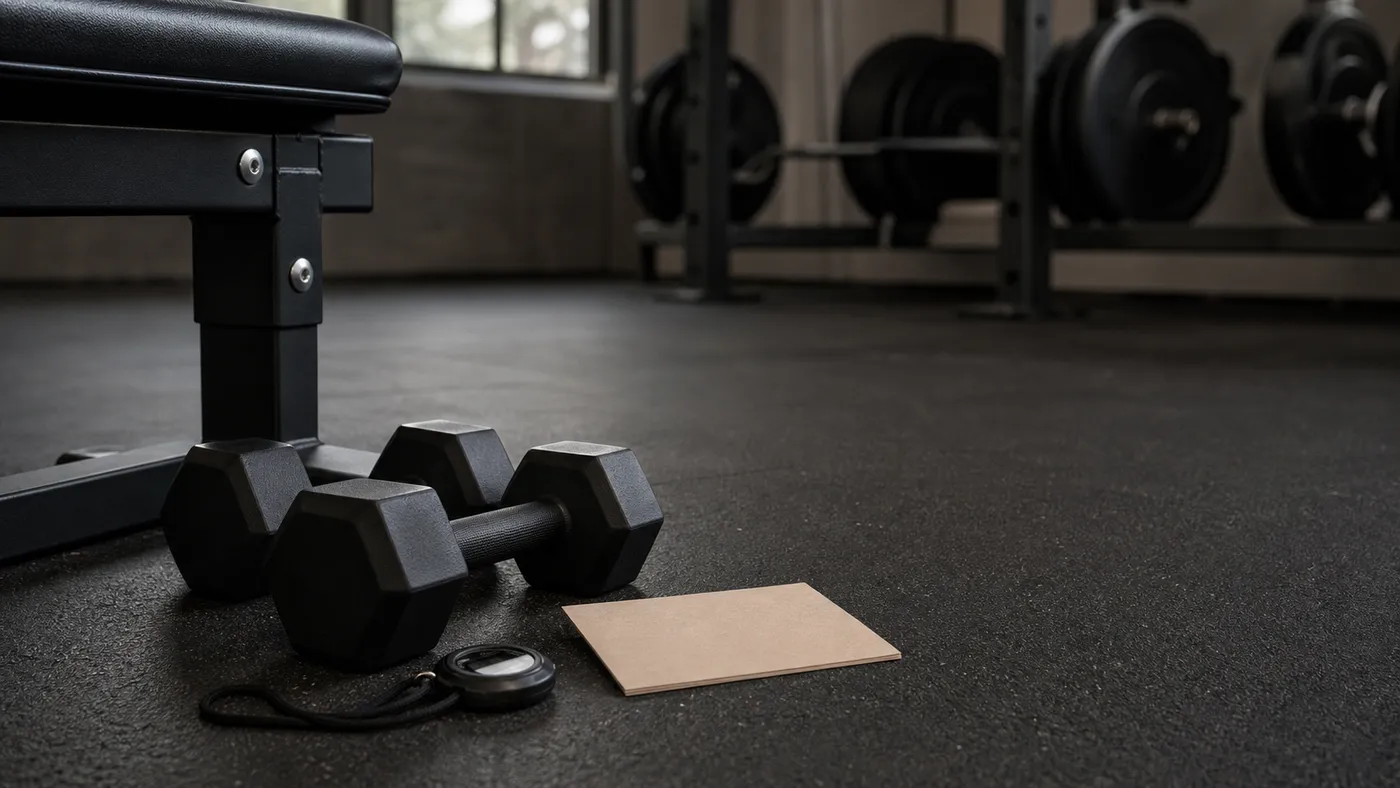 A small repeatable block is enough to see whether you are becoming more efficient or simply cutting recovery too far.
2. Keep quality next to the clock
Record the load, reps, and a simple effort note alongside the elapsed time. If the block gets faster while those markers stay similar, your density probably improved. If the clock improves but reps fall, technique degrades, or every set becomes a grinder, the time saved is not a win.
This is why rest times matter. Rest is part of the training dose. It should be intentional enough that a faster session actually means something.
3. Change one lever at a time
To raise density, first remove accidental downtime: wandering around, deciding the next exercise late, or letting a short rest become a five-minute phone break. Then make one deliberate change, such as shortening accessory rest by 15 seconds or pairing a non-competing movement.
Do not add sets, cut rest, and increase load all in the same week. You will not know which change drove the result—or which one created the fatigue.
Common mistakes with training density
The biggest mistake is treating density as a test of toughness. It is not. Your goal is more useful work for the time available, not the shortest possible workout.
Another mistake is confusing fast reps with higher density. Rushing a rep often changes technique or reduces control; density is about the structure of the session, not bouncing the weight. Finally, avoid comparing unlike days. A six-set accessory block after an easy full-body session is not directly comparable with the same block after heavy deadlifts.
The practical takeaway
Use training density when you want a reliable way to make accessory work, paired exercises, or time-limited sessions more efficient. Keep the important work comparable, protect rest when it supports performance, and judge the result by quality as well as the clock.
A focused workout log makes that easy to review later. In Steady, keep your sets, reps, load, and the session history together, then use a repeatable block to notice whether your training is becoming more efficient without becoming more chaotic.
Ready to start applying progressive overload?
Ditch the spreadsheets and complex notes. Join thousands of lifters who use Steady to focus on the workout, track their progress, and automatically know when to add weight.
Download Free for iPhone