How to Use Supersets Without Hurting Performance
Supersets work best when they save time without stealing performance from the exercises that matter. Pair movements that do not compete for the same muscles, keep enough rest after the pair, and avoid using supersets as an excuse to rush every set.
The goal is not to make the workout feel harder for its own sake. The goal is to keep productive volume high while trimming the dead time between compatible exercises.
If you already know what a superset is, this guide is about the next question: how do you actually use them without turning your session into a conditioning circuit?
Start With the Right Kind of Pair
The safest default is an antagonist superset: two exercises that train opposing or mostly separate muscle groups.
Good examples:
- Bench press + chest-supported row
- Dumbbell curl + triceps pressdown
- Leg extension + leg curl
- Lateral raise + calf raise
- Cable fly + face pull
These pairings work because one movement does not heavily fatigue the main muscles of the other. Your chest rests while your back works. Your biceps rest while your triceps work. You are still training, but the local muscle you just used gets a real break.
Same-muscle supersets can be useful, but they are a sharper tool. Pairing leg press with walking lunges or lateral raises with overhead press can be great for a pump, but it will reduce output on the second exercise. That can be fine for hypertrophy accessory work. It is usually a poor choice for heavy strength work.
Protect Your Main Lift
Do your most important lift first, either as straight sets or paired with something that will not interfere.
If your priority is getting stronger on squats, do not superset heavy squats with heavy Romanian deadlifts. Both ask a lot from your hips, back, bracing, and attention. You might save a few minutes, but the quality of both movements will drop.
A better setup:
- Squat as straight sets.
- Then superset leg curls with calf raises.
- Then superset leg extensions with abs.
That keeps the highest-skill, highest-load work clean while still making the rest of the workout more efficient.
For upper body sessions, you can be more flexible. A bench press and row pairing often works well because the exercises balance each other and usually do not share the same limiting muscle. Still, the rule stays the same: if the second exercise makes the first one worse, change the pair or add more rest.
 Small, opposing-muscle supersets are usually easier to recover from than pairing two heavy compound lifts.
Rest After the Pair, Not After Every Exercise
A common mistake is treating a superset like a race:
- Exercise A
- Exercise B
- Ten seconds of breathing
- Repeat
That is not efficient strength training. That is just compressed fatigue.
For most hypertrophy work, rest 60 to 120 seconds after completing both exercises. For heavier pairs, rest two to three minutes if needed. The rest period should be long enough that your next round is productive, not just survivable.
Use performance as your check. If your reps drop hard after the first round, your rest is too short, the pairing is too aggressive, or both. A small decline is normal. A collapse is feedback.
Keep the Logistics Simple
The best superset on paper can fail in a real gym.
If one exercise needs a bench on the far side of the room and the other needs a cable station that is always busy, you will spend more time guarding equipment than training. That creates friction for you and for everyone else using the gym.
Choose pairings that are close together:
- Dumbbells + nearby bench
- Cable curl + cable pressdown
- Pull-up bar + push-up handles
- Leg extension + leg curl machines beside each other
- Bench row + dumbbell press on the same bench
Good supersets should feel smooth. If the setup makes you anxious, rushed, or territorial, pick a simpler pair.
Use Supersets for Accessories First
If you are unsure where to start, add one superset pair near the end of the workout.
For a push day:
- Main press: straight sets
- Secondary press: straight sets or light pairing
- Lateral raise + triceps pressdown
For a pull day:
- Main row or pull-up: straight sets
- Secondary pull: straight sets
- Rear delt fly + biceps curl
For legs:
- Squat or leg press: straight sets
- Hip hinge: straight sets
- Leg extension + leg curl
This gives you most of the time-saving benefit without putting your most important work at risk.
How to Track Supersets in Steady
Steady supports supersets without turning your workout log into a separate circuit mode. You can link exercises into a superset in a routine, or create one during an active workout when the session changes in real life.
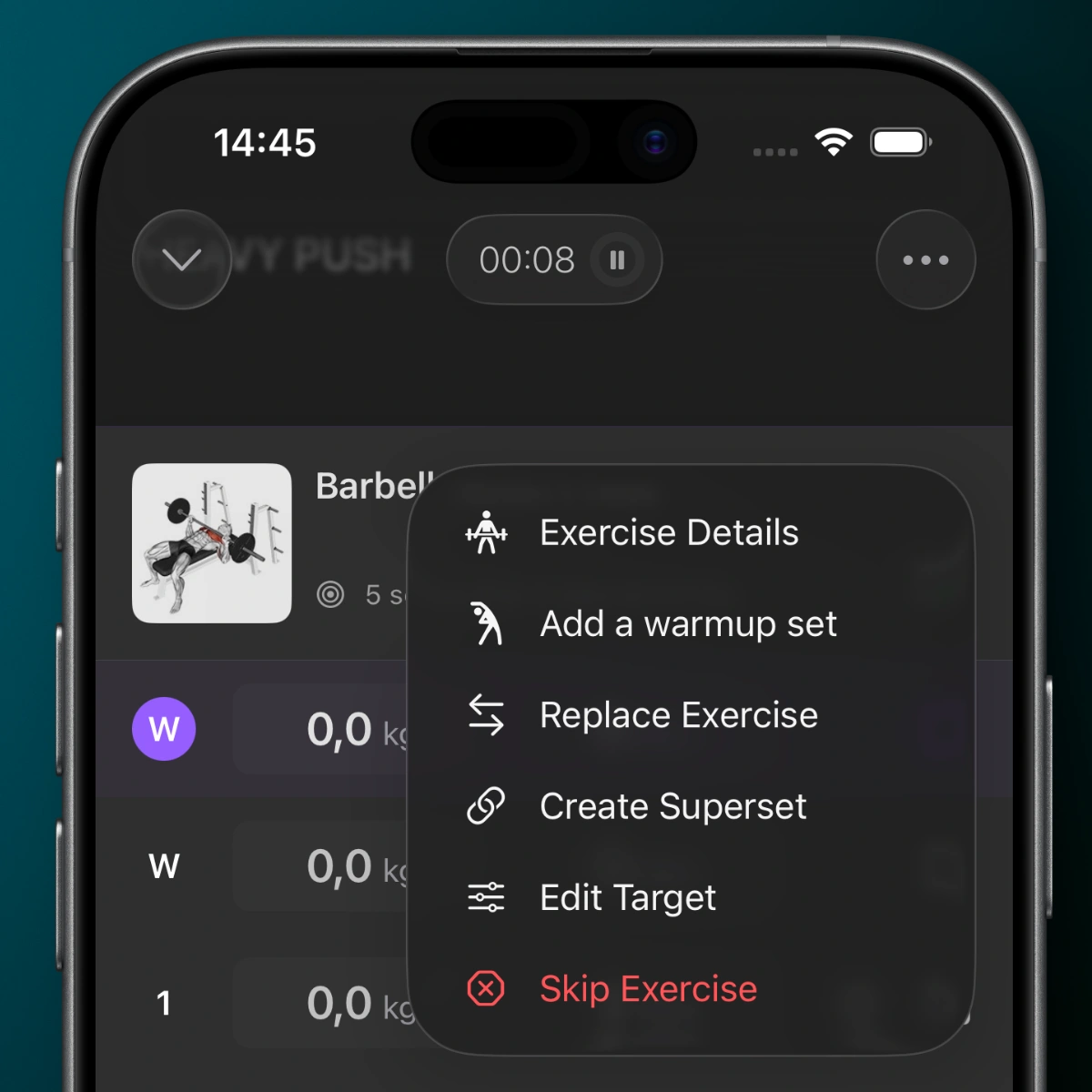 On-the-fly supersets are useful when the gym layout or equipment availability changes mid-session.
Once exercises are grouped, Steady keeps the group together and moves the active set through the pair in order. That matters because each exercise still keeps its own weight, reps, targets, and history. A superset should make the flow faster, not blur the data you need for progressive overload.
For clean tracking, log each exercise normally. If your bench press drops because you paired it with something too demanding, you want that visible in your history instead of hidden inside a vague “fast workout” note.
Signs a Superset Is Hurting Performance
Change the pairing if you notice any of these:
- Your technique gets worse after the first round.
- The second exercise always loses several reps.
- You need to lower loads dramatically just to finish.
- You feel out of breath before the target muscle is challenged.
- You avoid the pair because the setup is stressful in a busy gym.
Stop the movement if it causes sharp, worsening, or persistent pain. Do not try to solve that with a different superset; get guidance from a qualified clinician when needed.
None of these mean supersets are bad. They mean that specific pairing is not doing the job you wanted.
The Bottom Line
Supersets are useful when they make a workout denser without making your training sloppier. Start with one antagonist or accessory pair, keep the exercises close together, rest after the full pair, and watch your numbers.
If performance stays stable, the superset is probably helping. If your reps, load, or technique fall apart, simplify the pairing.
Steady makes this easier to see because each exercise keeps its own log, history, and progression data. Use supersets to make the session flow better, then let the numbers tell you whether the tradeoff was worth it.
Ready to start applying progressive overload?
Ditch the spreadsheets and complex notes. Join thousands of lifters who use Steady to focus on the workout, track their progress, and automatically know when to add weight.
Download Free for iPhone