How to Rebalance Workout Weights
Rebalancing workout weights means updating the planned loads across a routine or program to better match what you can lift now. It is useful when a program has drifted far from your current strength—not when one hard set has a bad day.
Normal progression should handle the small, earned changes: another rep, then a modest load increase. Rebalancing is the occasional reset for a plan that has become broadly too easy, too hard, or stale after time away. Think of it as bringing the written targets back in line with the lifter, while keeping the program itself intact.
When should you rebalance workout weights?
The best reason is a pattern, not a single workout. Consider a reset when one of these situations is clearly true:
- You have returned to a program after training something else for a while.
- Many targets now feel too heavy at once, even though recovery and technique are reasonably normal.
- Many targets have become easy enough that your regular, cautious progression is no longer catching up.
- You imported or copied a program and its starting weights do not resemble your current training.
This is different from a deload. A deload makes one workout or a short stretch easier so you can recover. A rebalance changes the future targets in the program. It is also different from lowering one exercise because a machine is busy or your shoulder feels off that day; that is a session-level decision, not a reason to rewrite the whole plan.
What a good reset changes—and what it should not
A useful rebalance adjusts target weights while leaving the training structure alone. Your exercise selection, set count, rep ranges, and weekly arrangement should still have a job to do. If those pieces are wrong, the answer is to edit the program, not merely put new numbers beside it.
The goal is not for every target to rise. Some may go up, some down, and some stay right where they are. That is a feature, not a flaw. Different exercises move at different rates, and a trustworthy plan should reflect that instead of pretending your whole body progresses in lockstep.
 A reset works best when it is based on a clear training pattern, not a guess after one session.
A practical way to rebalance your program
Before changing anything, look back at a representative run of workouts. You are looking for a repeated mismatch between the written target and the work you can actually perform.
- Check several sessions, not one. Sleep, stress, unfamiliar equipment, and a rushed warm-up can all make a normal target feel wrong once.
- Separate a broad issue from a single-exercise issue. If only one lift is lagging, adjust that exercise and investigate why. If many targets have drifted, a program-wide review makes more sense.
- Keep your rep ranges honest. A heavier target that forces you far below the intended range is not an upgrade. A lighter target that you can own cleanly is often the better starting point.
- Reset reps deliberately after a weight change. When a load moves up, beginning again at the lower end of the range gives you room to build. That is the same logic behind double progression.
- Run the revised targets long enough to learn from them. Do not rebalance again after two sessions unless something is clearly wrong. Let normal progression do the fine-tuning.
The biggest mistake is treating a reset as a shortcut to more aggressive loading. A program becomes useful when its targets are credible enough to repeat. Chasing a number that you cannot reproduce only makes the log less informative.
How Rebalance Weights works in Steady
Steady’s Rebalance Weights feature is designed for exactly this occasional course-correction. From a program or routine, it builds a preview of target-weight changes from your current strength estimates. You review the proposed changes before applying them.
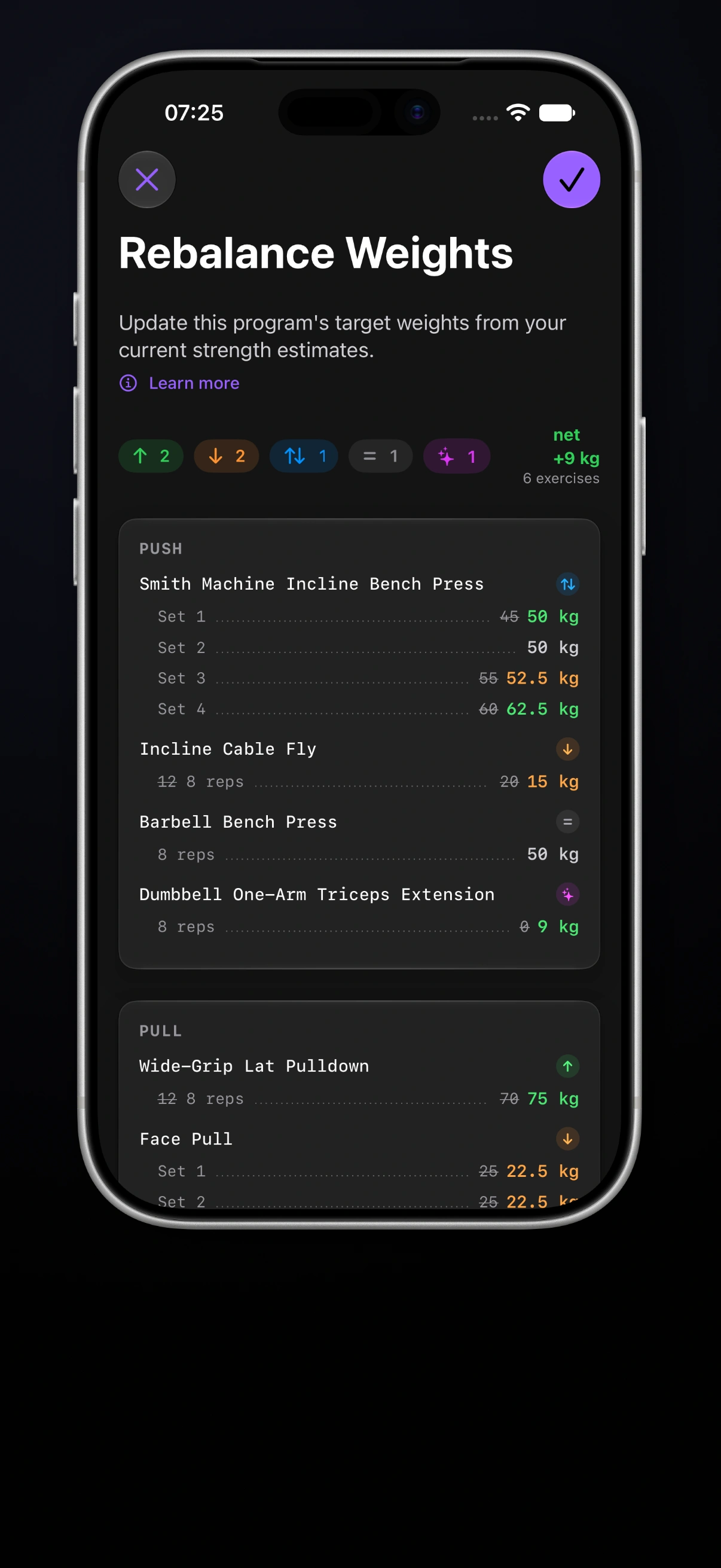 The preview makes the changes visible before you confirm them, including targets that are already on track.
It can work across a whole program or a single routine. The preview distinguishes increases, reductions, targets that are already aligned, and—when available—starting-weight estimates for exercises you have not yet performed. That makes the outcome something you can inspect, not a silent bulk edit.
Importantly, Rebalance changes target weights, not the program’s exercises, sets, or structure. When a weight changes, the rep target starts again at the bottom of its range so you have a clean runway to build back up. If an exercise has never been trained, Steady may be able to offer a starting estimate; if it cannot, your history-backed changes can still be reviewed on their own.
The feature needs enough logged training to make a meaningful comparison, and it is part of Steady Pro. If the preview says you are not ready yet, keep logging consistent working sets rather than forcing a broad reset from too little data.
Use the reset sparingly
Rebalance Weights is most valuable when it stays occasional. Use it after a genuine change in your training reality: returning to an old plan, outgrowing its written numbers, or discovering that a copied plan starts in the wrong place.
For everything between those moments, let your usual tracking do its work. Log comparable sets, keep the target rep range stable, and make earned adjustments one exercise at a time. Steady gives you a focused way to see the bigger correction when you need it—without turning every workout into a spreadsheet overhaul.
Ready to start applying progressive overload?
Ditch the spreadsheets and complex notes. Join thousands of lifters who use Steady to focus on the workout, track their progress, and automatically know when to add weight.
Download Free for iPhone