How to Prepare for a Workout: A 60-Second Check

The best way to prepare for a workout is to spend one quiet minute confirming what you are training, what you did last time, and what a good first working set should look like. That small check removes most of the guessing that makes the start of a session feel scattered.
You do not need a motivational ritual or a detailed new plan every time you enter the gym. You need a clear next action: the session you are doing, the first exercise, and a sensible target for it. Once those are decided, the warm-up and the first set have a job.
The 60-second pre-workout check
Use this sequence after you arrive and before you begin warming up:
- Confirm the session. Know whether today is your upper day, lower day, full-body session, or another planned workout. If you changed the plan, decide why before you start improvising.
- Look at the first lift. Check the exercise, target sets and reps, and the load or rep goal you are trying to beat or repeat.
- Remember the last session. Note anything that changes today’s decision: a missed rep, an easy top set, a longer rest period, pain, or a machine that was unavailable.
- Check the time you have. A 45-minute session can still be productive, but it may change how much accessory work fits after the main lifts.
- Pick one adjustment only if needed. Lower the target after a poor night of sleep, swap an unavailable exercise, or hold the load steady. Do not redesign the whole workout from a doorway.
The aim is not to predict a perfect workout. It is to make the opening decisions while you are calm, so you can pay attention to lifting once the work begins.
Why the first few minutes matter
Without a pre-workout check, lifters often use their warm-up sets to decide everything at once. They browse exercises, estimate their last weight from memory, debate how hard to push, and then call the result “autoregulation.” Some adjustment is useful; unplanned uncertainty is not.
A quick look at recent performance gives your warm-up context. If you hit 80 kg for eight clean reps last week, 80 kg is a reasonable reference point today. If that set was a grind after poor sleep, the same number may be a target to repeat rather than exceed. The log does not make the decision for you, but it gives the decision a starting point.
 A short plan is most useful when it leaves you ready to start rather than adding another task to the session.
What to decide before the first working set
The smaller the decision, the more likely you are to make it well. Before your first working set, settle these three things:
Your target
Use a target that reflects the last comparable session. It might be the same weight and reps, one more rep, or a modest load increase. If you are learning how to make that call, How to Use Workout History to Choose Weights is a useful companion.
Your constraint
Name the thing most likely to alter the session: limited time, low energy, a crowded gym, or a sore joint. Then choose the smallest response that protects the training goal. For example, keep the compound lift and trim one isolation exercise when time is short. Do not turn one constraint into permission to abandon the session.
Your first cue
One technical reminder is enough. “Brace before the descent” for a squat or “pause at the bottom” for a row gives attention somewhere useful to go. Trying to remember six cues at once usually means remembering none of them.
Use the overview, not just your memory
Memory is especially unreliable when you are busy or returning after a few days away. A workout tracker should put the useful context near the start, instead of making you dig through old sessions with one hand on a dumbbell.
In Steady, the Pre-Workout Overview appears above the exercise list before a routine-based workout starts. It shows the session number, targeted muscles, estimated duration, time since the last session, and either recent PRs or your place in the routine. When lifts are ready to move forward, it also surfaces progression opportunities before you start.
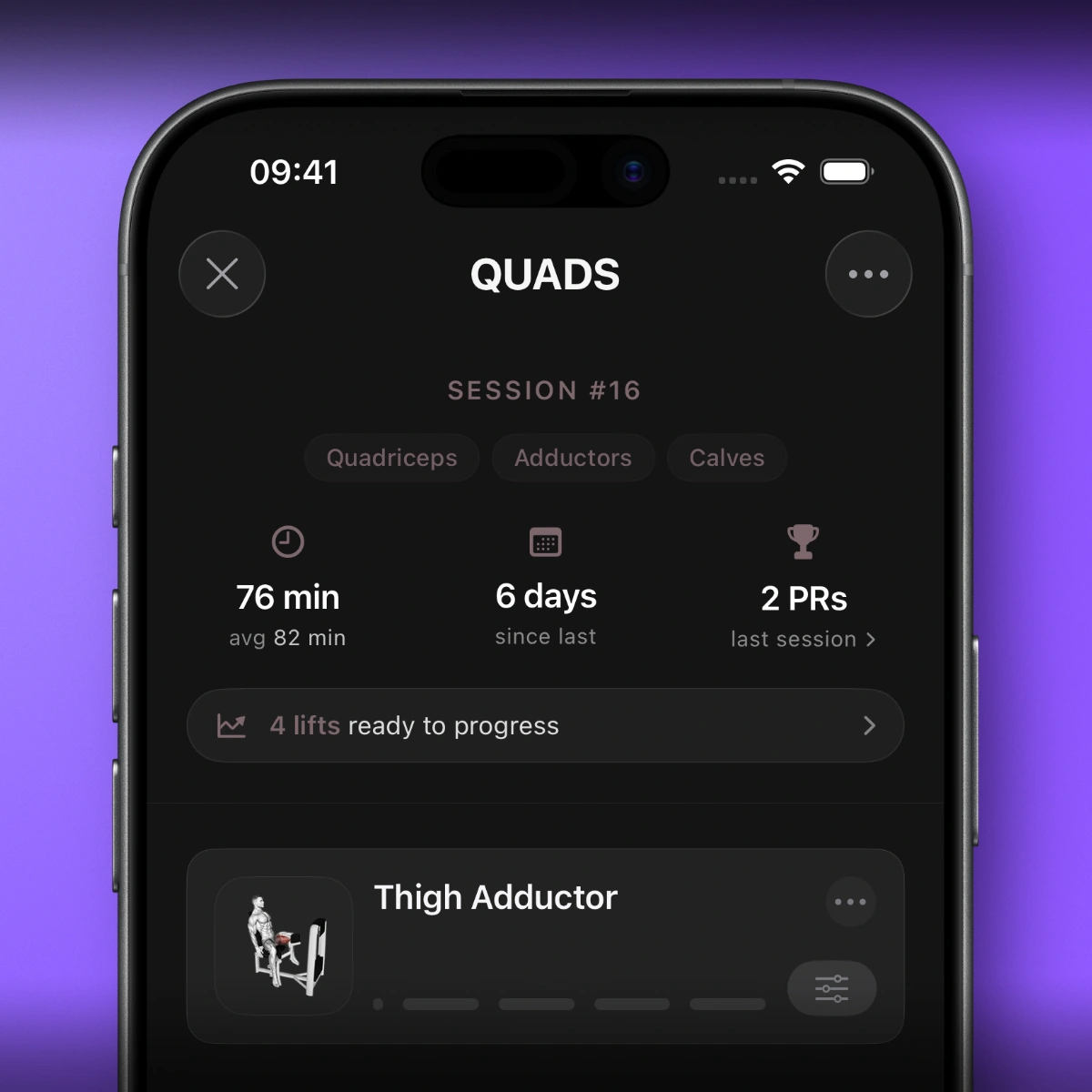 The overview is there for the planning moment before the session—not as another screen to manage while you lift.
There is an important limit: this view is tied to a routine and is available before the workout begins. Once you start, the job changes from planning to logging the work. That separation is useful. Check the context once, then let the active workout stay focused on sets, reps, and rest.
Common pre-workout mistakes
- Changing exercises because a new option looks interesting. Keep unfamiliar variations for a planned test, not a random Tuesday.
- Forcing progression after a bad warm-up. A repeat performance is often the right result when readiness is clearly down.
- Making the plan so detailed that you delay starting. The goal is clarity, not administration.
- Ignoring the previous session entirely. If every workout starts from a blank slate, it is much harder to see whether you are progressing.
Start with a plan you can actually follow
Your pre-workout check should make the gym feel simpler: here is today’s session, here is the first lift, and here is the next honest target. That is enough to begin with intent and adjust intelligently when the day asks for it.
Steady keeps that context close without turning training into a feed, a store of programs, or a pile of setup screens. Open your routine, take the minute before the first set, and let the rest of the workout be about doing the work.
Ready to start applying progressive overload?
Ditch the spreadsheets and complex notes. Join thousands of lifters who use Steady to focus on the workout, track their progress, and automatically know when to add weight.
Download Free for iPhone