How to Plan a Maintenance Phase

A maintenance phase is a planned block where you stop trying to push progress aggressively and focus on holding your current strength, muscle, and training habit with less total stress. Most lifters can maintain a lot of their progress with less volume than they needed to build it, as long as they keep training with enough intensity and consistency.
That makes maintenance useful when life gets busy, recovery is strained, dieting is hard, travel is coming up, or you simply need a block where training supports your life instead of taking the lead.
Maintenance phase vs deload: what is the difference?
A deload is short, usually about one week, and its job is to reduce accumulated fatigue so you can return to hard training. A maintenance phase is longer, usually two to eight weeks, and its job is to preserve results while lowering the demand of training.
The difference is intent:
- Deload: recover now so you can push again soon.
- Maintenance phase: hold steady for a season while other priorities take more space.
If you are beat up after a hard training block, start with a deload week. If you are not necessarily exhausted but cannot keep chasing progress at the same pace, a maintenance phase is the better tool.
When a maintenance phase makes sense
Maintenance is not quitting. It is a strategic hold.
Use one when:
- Your schedule is temporarily tighter, and long sessions are becoming inconsistent.
- You are in a calorie deficit and recovery is less predictable.
- You have been pushing volume for months and want to keep training without adding more fatigue.
- You are traveling or entering a stressful work period.
- You want to protect strength while shifting focus to conditioning, sport, or general life bandwidth.
The best time to plan maintenance is before training starts falling apart. Waiting until every session feels rushed usually means you will cut randomly. A planned maintenance phase lets you decide what stays important.
Keep intensity, reduce volume
The simplest maintenance rule is this: keep some challenging sets in the program, but do fewer total sets.
You do not need to keep every exercise, every accessory, or every weekly set. You do need enough exposure to the movements and muscles you want to maintain.
 Maintenance should feel calmer than a growth phase, but it still needs enough structure to protect the work you have built.
For most lifters, a maintenance phase works well with:
- About one third to two thirds of your usual hard-set volume
- At least one or two challenging sets per main movement pattern each week
- Loads that still feel like real training, not just movement practice
- A few reps in reserve on most sets instead of constant grinding
If you normally train chest with 12 hard sets per week, you might maintain well on 5-8 good sets for a while. If your normal lower-body training is 16 hard sets, you might temporarily hold with 6-10 carefully chosen sets.
The exact number depends on training age, muscle group, sleep, nutrition, and how hard the sets are. The point is not to find the minimum possible dose forever. It is to create a realistic block you can actually repeat.
What to cut first
Cut the least important work first, not the hardest work automatically.
A good order:
- Remove duplicate accessories. If you have two triceps isolations, keep one.
- Trim extra sets from exercises that already get indirect work. Front delts get plenty from pressing; biceps get work from rows and pulldowns.
- Keep the main patterns. Squat or leg press, hinge, press, row, pull, and a few targeted accessories should still appear.
- Shorten sessions by lowering volume, not by rushing rest. Fast, sloppy maintenance training can turn into worse recovery with worse performance.
You can also reduce training days if needed. A four-day routine can become three. A six-day routine can become four. Just make sure the new split still touches each priority muscle at least once or twice per week.
Example: turning a growth block into maintenance
Imagine your normal upper-body hypertrophy week looks like this:
- Bench press: 4 sets
- Incline dumbbell press: 3 sets
- Cable row: 4 sets
- Lat pulldown: 3 sets
- Lateral raise: 4 sets
- Rear delt fly: 3 sets
- Biceps curl: 3 sets
- Triceps pressdown: 3 sets
For maintenance, you could run:
- Bench press: 3 sets
- Cable row: 3 sets
- Lat pulldown: 2 sets
- Lateral raise: 2 sets
- Biceps curl: 1-2 sets
- Triceps pressdown: 1-2 sets
That keeps pressing, rowing, vertical pulling, shoulders, and arms in the week, but cuts the total demand sharply. You are still training. You are just not trying to maximize growth during this block.
How long should maintenance last?
Two to four weeks is enough for a busy stretch. Six to eight weeks can work during a longer diet, travel season, or life phase where training is not the main priority.
If you go longer than eight weeks, reassess. Maintenance can be productive, but it should not become accidental stagnation. Ask:
- Am I maintaining strength on key lifts?
- Is body weight stable, if that matters for the goal?
- Do joints and motivation feel better than they did before?
- Am I ready to add volume again, or is this phase still useful?
If performance is dropping quickly, the phase may be too light. If fatigue is still climbing, you probably did not reduce enough.
Where this fits in Steady
In Steady, the practical maintenance question is simple: are your weekly set targets still matching the phase you are in?
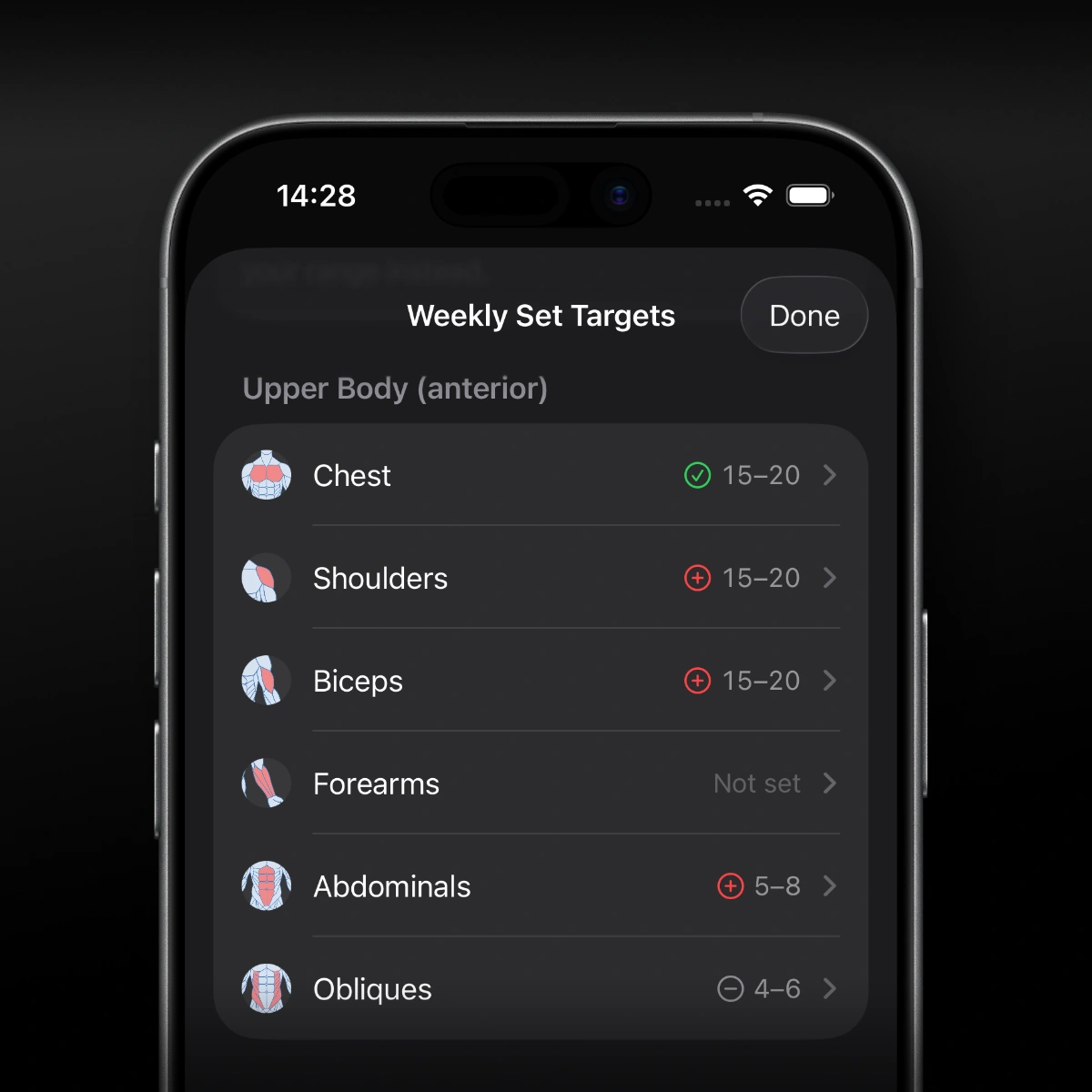 Weekly set targets make it easier to lower volume intentionally instead of randomly deleting exercises when life gets busy.
During a growth phase, you might aim for more weekly sets on priority muscles. During maintenance, you can lower those targets, keep the main exercises in place, and watch whether your recent sessions still cover the muscles you care about. That makes the phase visible in your log instead of something you are trying to remember.
This is also where consistent tracking helps. If your key lifts hold steady while sessions are shorter, the maintenance phase is working. If reps, load, and effort all slide for several weeks, that is a signal to adjust before the block turns into detraining.
Common maintenance mistakes
Cutting intensity too much
If every set is very easy, you are practicing movements more than maintaining training adaptations. You do not need max effort, but some sets should still feel meaningfully challenging.
Keeping the same volume and calling it maintenance
If the plan is just as long and demanding as before, nothing changed. Maintenance should reduce total stress.
Dropping the lifts you care about most
If you want to maintain squat strength, keep some kind of squat or close variation in the plan. If you want to maintain pull-up performance, keep vertical pulling in the week.
Treating maintenance like failure
Maintenance is part of long-term training. The goal is not to progress every metric every week forever. Sometimes the smart move is to hold your ground so you can push harder later.
Final thoughts
A maintenance phase is what you use when you want training to stay solid without demanding your best recovery, longest sessions, or highest motivation. Keep the important lifts, keep some challenging sets, reduce the extra volume, and decide in advance how long the phase should last.
The payoff is stability. You keep the habit alive, preserve most of what you built, and return to harder training with less friction.
Steady helps by keeping the numbers clear: sets, reps, loads, effort, and weekly volume all stay visible. That makes maintenance a deliberate training phase, not a vague stretch where you hope you are doing enough.
Ready to start applying progressive overload?
Ditch the spreadsheets and complex notes. Join thousands of lifters who use Steady to focus on the workout, track their progress, and automatically know when to add weight.
Download Free for iPhone