How to Know When to Stop a Set

The best time to stop a set is when you have reached the target reps with solid form, or when the next rep would clearly turn into a grind, a missed rep, or a technique breakdown. For most strength and hypertrophy work, that usually means stopping with 1-3 good reps in reserve. You trained hard enough to create stimulus, but not so hard that every set becomes a recovery problem.
This is where a lot of lifters get stuck. They know how many reps they planned to do, but not what should happen when the set feels easier or harder than expected. Do you stop at 10 because the plan said 10? Keep going because you can? Rack it early because rep 7 already felt awful?
The answer depends on the purpose of the set.
The Simple Rule
Stop the set when one of these is true:
- You hit the planned target with the intended effort.
- Your form is about to change in a way that changes the exercise.
- The next rep would likely fail.
- Continuing would add more fatigue than useful stimulus.
That last point matters. More reps are not automatically better reps. A set of 10 controlled leg curls taken to 1 rep in reserve is productive. Turning it into 14 half-reps because you refused to stop may just make your hamstrings cramp and your next set worse.
Hard training should still be directed. The goal is not to prove you can suffer. The goal is to get enough high-quality work to progress.
Stop at the Target When the Target Was Right
If your program says 3 sets of 8 and rep 8 feels like RPE 8 or 9, stop there. You did what the set was supposed to do.
This is the cleanest case:
- The target reps were hit.
- The last reps slowed down.
- Your range of motion stayed consistent.
- You probably had 1-2 good reps left.
That is a useful hard set. You do not need to chase extra reps just because the weight did not destroy you. A set can be productive without being maximal.
This is especially true when you still have more sets to do. If set 1 becomes a surprise all-out AMRAP, set 2 and set 3 may collapse. Then the workout becomes harder to interpret: did you need more effort, or did you spend too much effort too early?
Keep Going When the Set Is Clearly Too Easy
Sometimes the target was too conservative. Maybe you underestimated the weight, rested longer than usual, or came in fresh after a good night of sleep. If your target was 10 reps and rep 10 feels like you had 5 or 6 left, the set probably was not hard enough to count as a meaningful working set.
In that case, keep going until you get closer to the intended effort zone. A good stopping point is usually RPE 7-9, or about 1-3 reps in reserve.

The pause after a hard set is useful feedback. If you finish and feel like you barely trained, the set may need more reps, more load, or a clearer target next time.
There is one caveat: do not turn every easy set into a max test. If you are doing warm-ups, technique practice, clinician-led rehab work, or a deliberately easier deload session, easy is the point. But for a normal working set, stopping far from failure usually leaves progress on the table.
Stop Early When Form Starts Changing
Form breakdown is one of the clearest signs that a set is done.
That does not mean every rep must look identical. Hard reps move slower. Your face may look more focused. You may need to brace harder. That is normal.
The red flags are bigger:
- Your range of motion shortens without intending to.
- You bounce, twist, or shift to move the load.
- The target muscle stops doing the work.
- Your joints start feeling the set more than the muscle.
- The next rep would require a completely different technique.
If those show up, stop the set. You are no longer training the movement you meant to train. You are practicing compensation.
This matters most on exercises where failure has a bigger cost: squats, deadlifts, barbell bench press, heavy rows, overhead presses, and any movement where getting stuck can be risky. On a cable curl, one ugly final rep is usually just a bad rep. On a heavy squat, it can derail the whole session.
Stop Shorter on Compound Lifts, Push Closer on Safer Isolation Work
Not every exercise deserves the same stopping rule.
For heavy compound lifts, most lifters do better stopping around RPE 7-9. That usually leaves 1-3 reps in reserve. You still train hard, but you avoid turning every set into a technical max.
For stable isolation exercises, you can push closer. Leg extensions, lateral raises, machine curls, cable triceps pressdowns, and similar movements are usually safer to take near failure because they are easier to bail out of and less technically complex.
A practical approach:
- Big barbell lifts: stop when the next rep would be slow and questionable.
- Machine compounds: stop when the target muscle is close to done, but form is still honest.
- Isolation lifts: occasionally go to 0-1 reps in reserve, especially on the last set.
- New exercises: stop earlier until your technique is reliable.
This keeps effort high without pretending every movement has the same risk.
Use RPE and RIR to Make the Decision Repeatable
RPE and RIR are useful because they turn “I think that was enough” into something you can compare next time.
RIR means reps in reserve: how many good reps you could still have done at the end of the set. RPE is the same idea from the other direction.
If the terms are new to you, see our practical guide to using RPE without overthinking it.
- RPE 6: about 4+ reps in reserve
- RPE 7: about 3 reps in reserve
- RPE 8: about 2 reps in reserve
- RPE 9: about 1 rep in reserve
- RPE 10: no reps in reserve
For most normal working sets, RPE 7-9 is the sweet spot. If every set is RPE 6, you are probably undertraining. If every set is RPE 10, you are probably creating too much fatigue to recover and progress consistently.
How to Use This in Steady
Steady lets you log effort directly with RPE and RIR, so the stopping point becomes part of your training history instead of something you try to remember later. The app maps RPE 6-10 to practical effort labels and reps-in-reserve descriptions, so a hard set can be logged as both a number and a useful meaning.
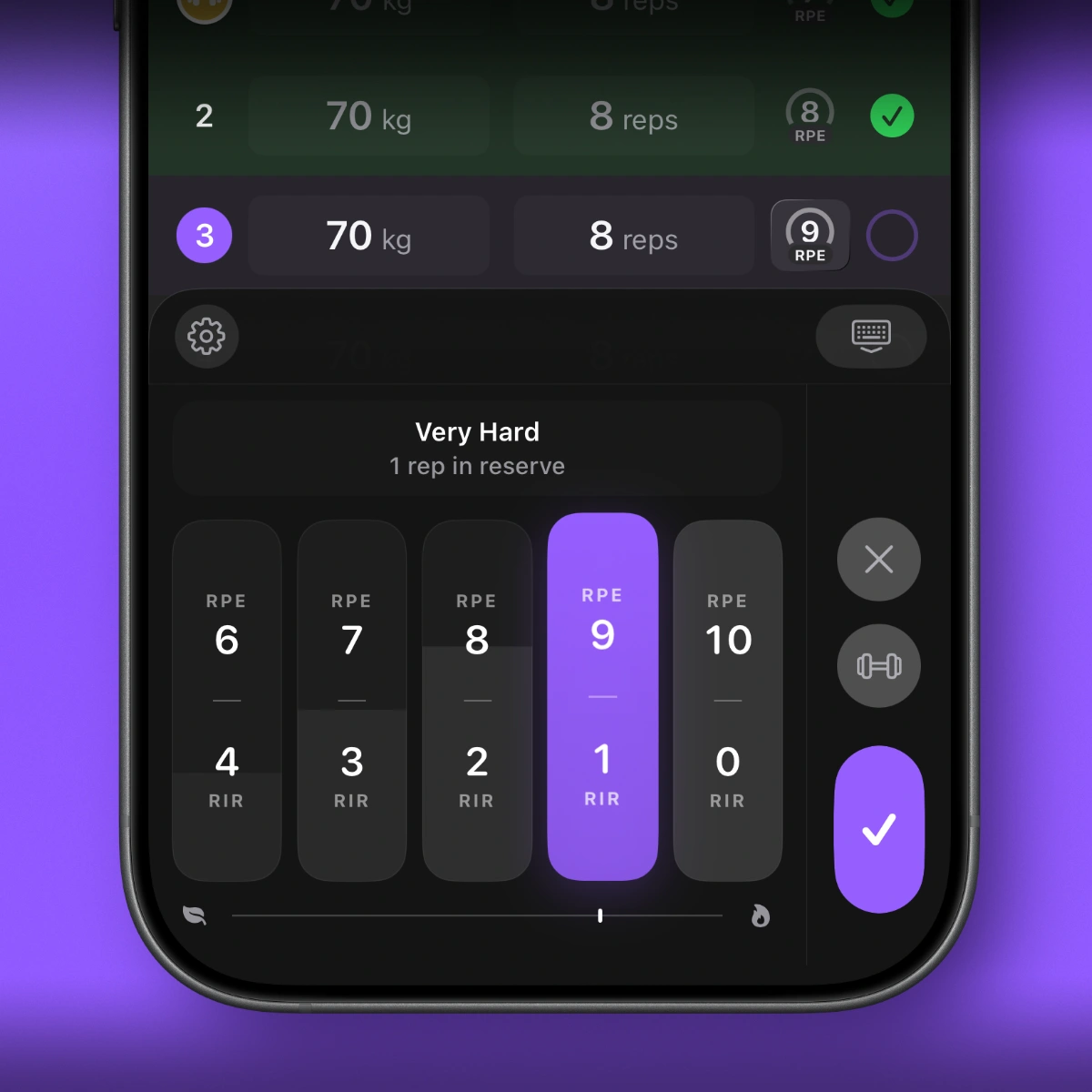 Logging RPE or RIR gives future-you context for whether a set was too easy, about right, or too close to the edge.
That context helps when you review a lift later. If you did 10 reps at RPE 6, you probably had room to add reps or load. If you did 10 reps at RPE 8, the set was right where most productive work lives. If you did 10 reps at RPE 10 and the next two sets fell apart, the better move next time may be to stop one rep earlier.
You do not need to log effort for every set forever. Start with your hardest working sets. Those are the sets where the stopping decision matters most.
Common Mistakes
The first mistake is stopping only because the planned number appeared. Targets guide the set, but they do not replace judgment. If the plan says 10 and 10 was clearly too easy, the set probably needs an adjustment.
The second mistake is treating failure as the default proof of effort. Failure can be useful, especially on safer isolation work, but it is expensive. If you need three days to recover from a workout that should have been repeatable, the extra reps may not have been worth it.
The third mistake is confusing discomfort with proximity to failure. High-rep leg work can burn long before the muscle is actually done. Heavy low-rep work can feel intimidating before it is truly near failure. RIR gets better with practice, so treat the first few weeks as calibration.
The Bottom Line
Stop a set when you have achieved the intended stimulus with honest form. Most of the time, that means stopping with 1-3 good reps left. Push closer to failure when the exercise is safe, the set is meant to be hard, and the extra effort has a purpose.
The more consistently you log weight, reps, and effort, the easier this decision becomes. Steady is built for that kind of training: focused tracking, useful context, and no noisy feed between you and the next set.
Ready to start applying progressive overload?
Ditch the spreadsheets and complex notes. Join thousands of lifters who use Steady to focus on the workout, track their progress, and automatically know when to add weight.
Download Free for iPhone