How to Build a Weekend-Only Workout Plan
A good weekend-only workout plan uses two full-body sessions with different priorities, so you train the major movement patterns without trying to repeat the same hard work on Saturday and Sunday. The goal is not to squeeze a five-day split into two days. It is to choose a small number of exercises you can recover from, progress on, and return to next weekend.
Training only on the weekend is not the theoretical ideal for everyone, but it can be a very effective real-world plan. If those are the two sessions you can protect every week, they are enough to build strength, muscle, and a dependable training habit.
The challenge of back-to-back training days
A two-day plan has one constraint that a Monday/Thursday schedule does not: your sessions happen with very little recovery between them. That changes how you organize the work.
Avoid making Saturday and Sunday identical full-body workouts. Heavy squats, hard Romanian deadlifts, pressing, rows, and a pile of accessories on both days can leave the second session flat before it starts.
Instead, give each day a different emphasis:
- Workout A: knee-dominant lower body, horizontal press, horizontal pull.
- Workout B: hip-dominant lower body, vertical pull, vertical press.
Both days still train the whole body, but no muscle group has to be the main event twice in a row. This is a useful compromise between a body-part split, which can leave each muscle waiting a full week, and two copy-pasted full-body sessions, which can be too fatiguing.
Start with the smallest workable weekly dose
For a weekend-only plan, start more conservatively than you think. Two or three hard sets for the main lifts and one or two sets for smaller movements is enough to establish a useful baseline.
The first few weeks should answer simple questions:
- Can you make good progress through both sessions?
- Are you ready to train when the next weekend arrives?
- Does one movement repeatedly make the next day worse?
If the answer is yes, you can add a set later. If you begin with too much volume, every adjustment becomes guesswork. A plan that ends with a little in reserve is easier to repeat than one that turns Sunday into survival mode.
Build two sessions around different jobs
Choose one exercise from each role below. The exact variation matters less than whether it feels good, is available at your gym, and can stay in the plan for several weeks.
Workout A: squat, press, row
- Squat, leg press, or hack squat: 3 sets of 6–10
- Bench press, dumbbell press, or machine chest press: 3 sets of 6–10
- Chest-supported row, cable row, or machine row: 3 sets of 8–12
- Leg curl: 2 sets of 10–15
- Lateral raise or triceps pressdown: 2 sets of 10–15
Workout B: hinge, pull, press
- Romanian deadlift, hip thrust, back extension, or seated leg curl: 3 sets of 6–10
- Lat pulldown or assisted pull-up: 3 sets of 8–12
- Overhead press or machine shoulder press: 2–3 sets of 8–12
- Split squat, leg extension, or calf raise: 2 sets of 10–15
- Curl, rear-delt fly, or ab work: 2 sets of 10–15
The template is deliberately short. You can make it more personal by choosing movements that fit your joints and equipment, but keep the roles stable. A weekend plan works best when you know what you are there to do.
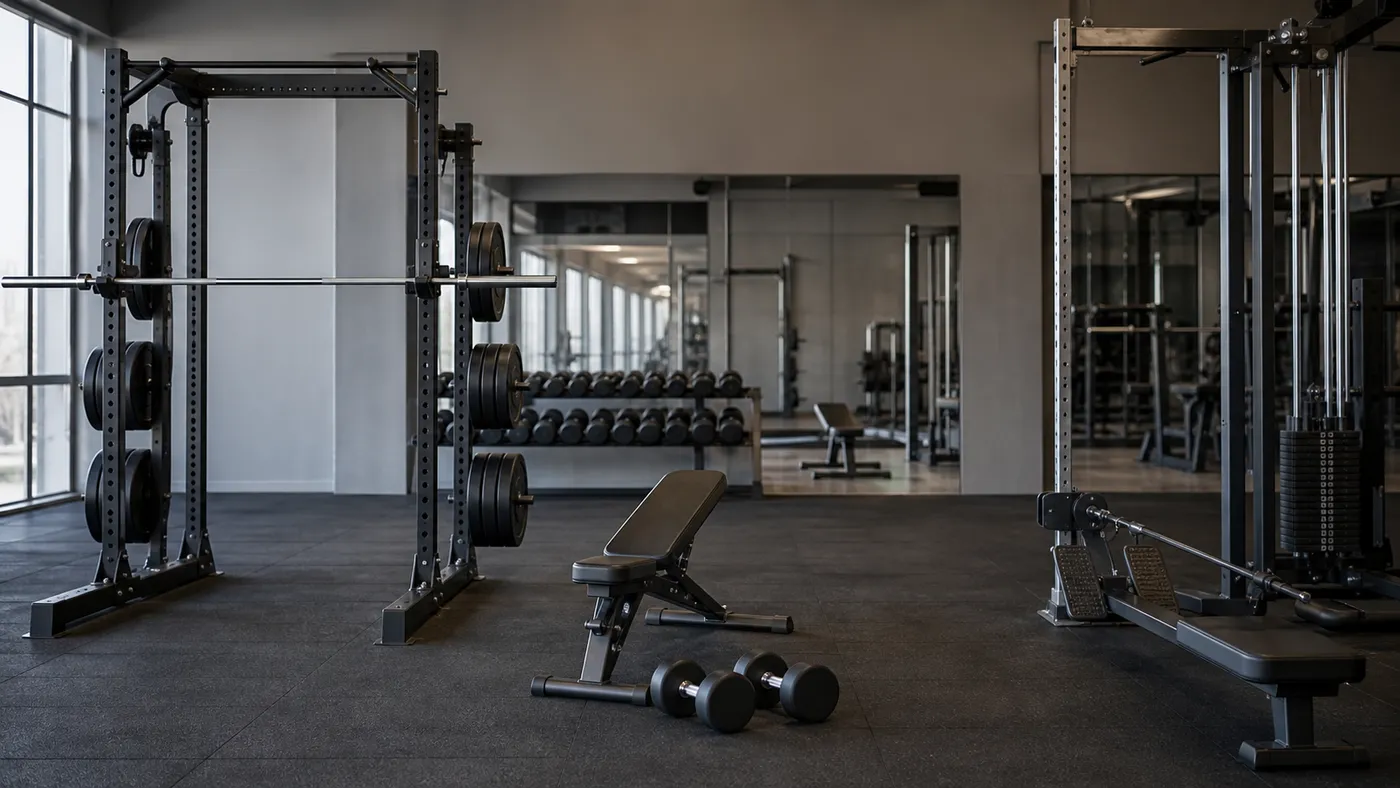
A two-session plan can cover the whole body when each station has a clear job instead of becoming a long checklist.
Put the most demanding lower-body work on one day
The biggest mistake with weekend training is treating both days as lower-body max-out days. You may be able to do it once, but the second session often becomes a collection of tired, lower-quality sets.
If Workout A includes hard squats or leg presses, let Workout B use a controlled hip hinge, hip thrust, or hamstring curl rather than another all-out knee-dominant movement. If deadlifts are the priority on Sunday, keep Saturday’s leg work challenging but not exhaustive.
This is not about avoiding effort. It is about placing effort where it can produce useful reps. One strong lower-body priority on each day is usually more productive than trying to win both days.
Progress one variable at a time
Use a simple rep-range rule. For example, with three sets of 6–10:
- Keep the weight the same while you add reps across the target sets.
- Once you reach the top of the range with controlled technique, add the smallest practical amount of load next weekend.
- If you miss the lower end of the range twice in a row, check recovery, exercise order, and total volume before changing the whole plan.
You do not need to progress every exercise every Saturday and Sunday. The point is to create a record clear enough to notice a trend. If you want more detail, How to Use Double Progression explains this approach without turning it into a spreadsheet project.
Make the plan resilient to a missed session
Life can still take one weekend day away. When that happens, do not restart the plan or try to cram both sessions into one marathon workout. Complete the session you can do, then start with the other session next weekend.
For example, if you finish Workout A on Saturday but miss Sunday, begin with Workout B the following weekend. That keeps the plan balanced over time and prevents your preferred day from always getting the freshest energy.
Keep your records useful, not complicated
A weekend-only routine benefits from clear records because seven days can pass between repeats. Log the exercise, load, reps, and any brief note that explains a meaningful change, such as a different machine, a poor night’s sleep, or an unusually crowded gym.
Steady gives the plan a focused home: keep Workout A and Workout B saved, log each session, and use the previous result as the starting point for the next weekend. You do not need a crowded workout store or a social feed to make two consistent sessions count.
Ready to start applying progressive overload?
Ditch the spreadsheets and complex notes. Join thousands of lifters who use Steady to focus on the workout, track their progress, and automatically know when to add weight.
Download Free for iPhone