How to Build a Dumbbell-Only Workout

A good dumbbell-only workout covers a squat or lunge, a hinge, a push, a pull, and a small amount of focused accessory work. You do not need a different exercise for every muscle or an elaborate circuit. Pick movements you can load and repeat, give each one a clear rep range, and progress them over time.
Dumbbells are one of the most practical ways to train. They work in a commercial gym, a small home setup, and the quiet corner of a busy floor. They also ask you to control each side independently, which can make lighter loads feel surprisingly demanding.
The trade-off is that dumbbells become awkward when the plan is too complicated. A useful session is not the one with the most variations. It is the one you can set up quickly, log honestly, and improve next week.
Start with movement jobs, not a long exercise list
For a balanced dumbbell-only session, give the workout four main jobs:
- Knee-dominant leg work: a goblet squat, split squat, or step-up.
- Hip-dominant leg work: a Romanian deadlift, hip hinge, or glute bridge.
- Upper-body push: a dumbbell floor press, bench press, or overhead press.
- Upper-body pull: a one-arm row, chest-supported row, or rear-delt row.
That is the foundation. If you have time and energy, add one or two accessories that fit your goal: lateral raises for shoulders, curls for biceps, triceps extensions, calf raises, or a loaded carry.
The point is coverage, not perfection. A full session of six well-chosen dumbbell movements beats twelve exercises that overlap, rush you, or leave no clear way to improve.
Choose exercises your setup can support
The best dumbbell plan respects the equipment and space you actually have. A home trainee may have an adjustable bench and a few pairs of dumbbells. A gym trainee may have every weight available but only one clear patch of floor. Both can make progress.
Start by asking three practical questions:
- Can I use this setup safely and consistently?
- Can I add a rep or a little load when I improve?
- Does this movement fill a job the rest of the workout does not already cover?
For example, a goblet squat and a Romanian deadlift give your lower body different work without requiring a rack. A floor press is an excellent push when there is no bench. A supported row is often easier to repeat cleanly than a row that turns into a balance test.
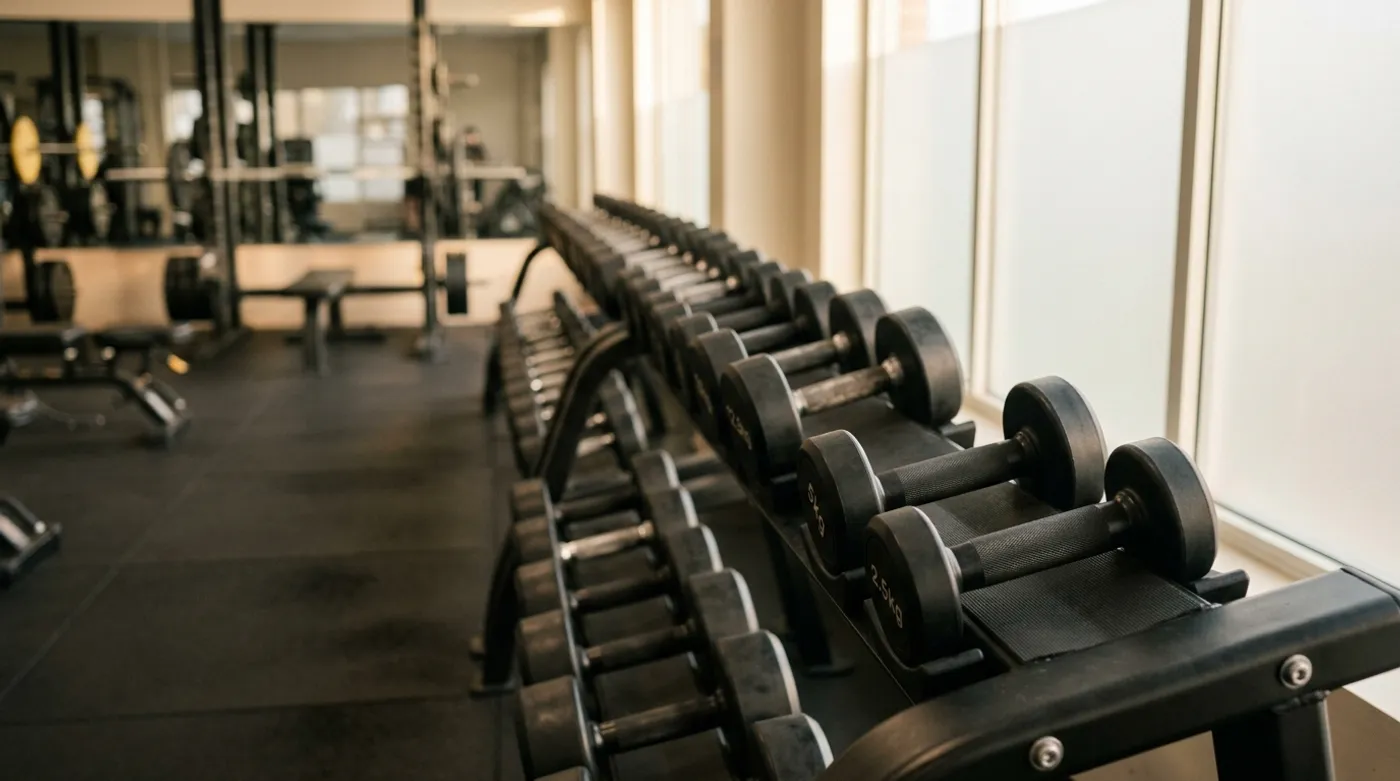 The useful pair is the one you can control today and make slightly harder over time.
If your dumbbells top out too light for a lower-body movement, do not rush to add random exercises. First make the current movement more demanding with a longer range of motion, a slower controlled lowering phase, a unilateral version, or a higher rep range. Change one variable at a time so your log still tells a clear story.
Use a simple full-body template
Most people do well starting with two or three dumbbell-only full-body sessions per week. Keep at least a day between sessions when you are new to the plan or returning after time away.
Here is a practical template:
| Movement | Example | Sets × reps |
|---|---|---|
| Knee-dominant legs | Goblet squat or split squat | 3 × 8–12 |
| Hip-dominant legs | Dumbbell Romanian deadlift | 3 × 8–12 |
| Push | Dumbbell floor press or bench press | 3 × 8–12 |
| Pull | One-arm or chest-supported dumbbell row | 3 × 8–12 |
| Shoulders or arms | Lateral raise, curl, or triceps extension | 2–3 × 10–15 |
You do not need to use every option in the table. Choose one exercise per job and keep it for several weeks. Consistency gives you a fair comparison; changing everything every session only creates novelty.
If three sessions feel like too much, run the template twice a week and keep the sets hard enough to matter. If you already recover well and enjoy more training, alternate two versions: one beginning with a squat and floor press, the other beginning with a split squat and overhead press. The structure stays familiar while the emphasis shifts slightly.
Make progression boring on purpose
Dumbbell progress is often quieter than adding a large plate to a barbell. That is normal. The cleanest approach is double progression: keep a rep range, earn more reps with the same pair, then move up when you own the top of the range.
Say you use 20 kg dumbbells for three sets of 8–12 presses:
- Session one: 10, 9, 8 reps.
- Session two: 10, 10, 9 reps.
- Session three: 11, 10, 10 reps.
- When you can repeat 12, 12, 12 with control, use the next pair and build again.
If the next available pair is a large jump, keep the current load longer. Add a rep to one set, improve control, or use a longer rep range such as 10–15. Do not force a jump that turns every set into a grind.
Keep the log focused on the next decision
For each working set, record the dumbbell weight, reps, and any detail that changes the comparison. With adjustable dumbbells, that might be the exact increment. With a unilateral movement, note whether the listed reps are per side. With a floor press versus a bench press, treat them as different exercises rather than merging the numbers.
You do not need a complicated spreadsheet to make this work. You need a record that answers one question when you come back: repeat this, add a rep, or choose a slightly heavier pair? A focused tracker like Steady keeps that decision close to the workout instead of burying it under a feed or a catalogue of routines.
Avoid the common dumbbell-only traps
Making every exercise unilateral. Single-arm and single-leg work is useful, but doing every movement one side at a time can turn a short session into a long one. Keep the movements that earn the extra time; use bilateral dumbbell options elsewhere.
Chasing variety before progress. A new press angle every week prevents a clear baseline. Keep most exercises stable long enough to learn what a better performance looks like.
Treating light dumbbells as a reason to rush. Fast, loose reps are not a substitute for load. Use a controlled range and choose a rep target that makes the set challenging without turning it into a sloppy race.
Forgetting the hinge or pull. Many dumbbell workouts become squats, presses, curls, and more presses. Put a hinge and a row on the plan before adding extra arm work.
Build the workout you will repeat
A dumbbell-only workout does not need to be a compromise. It can be a complete, repeatable strength plan when each movement has a job and each week has a clear next step. Start with four main patterns, add only the accessories you can recover from, and let steady progress—not constant novelty—shape the plan.
Open Steady, log the first honest session, and give your future self a simple target to beat.
Ready to start applying progressive overload?
Ditch the spreadsheets and complex notes. Join thousands of lifters who use Steady to focus on the workout, track their progress, and automatically know when to add weight.
Download Free for iPhone