Full Body vs Split Routine: Which Is Better?

If you can only train two or three days per week, a full body routine is almost always the better choice. If you can train four or more days per week and want to push each muscle group harder in a single session, a split routine tends to work better. Most of the disagreement about “full body vs split” disappears once you know how many days you can actually protect on your schedule.
Both approaches build muscle and strength. The question isn’t which one is objectively superior — it’s which one fits your week, your recovery, and your goals. This post walks through how each approach works, where each one shines, and how to pick without overthinking it.
Short definitions
A quick pass on the terms before going further.
- Full body routine: a workout that trains most major muscle groups in a single session — typically chest, back, legs, shoulders, and arms in one go.
- Split routine: a program that divides muscle groups across different days, so each session focuses on a subset (for example, upper body one day, lower body the next).
- Training frequency: how many times per week you train a given muscle group.
- Training volume: the total amount of productive work — usually counted in hard sets per muscle group per week.
- Recovery: the time a muscle needs between hard sessions to come back stronger.
How full body routines work
A full body routine hits every major muscle group in one session. On a typical full body day, you’ll do one or two exercises for each main movement pattern — a squat, a hinge, a press, a pull, and something for your core or accessories.
Because you’re covering everything, each muscle group gets a moderate amount of work per session. The payoff is frequency: if you train full body three times a week, every muscle group gets trained three times a week. That frequency adds up fast, even with fewer total sets per session.
Full body works best when:
- You train two or three days per week.
- You want a program that still progresses when life gets in the way and you only make it to the gym twice.
- You’re relatively new to lifting, or returning after a break.
- You prefer shorter, denser sessions over long ones.
It tends to struggle when you want to push a single muscle group really hard — by the time you get to your fifth exercise of the day, you won’t have the same intensity you had on the first one.
How split routines work
A split divides the body across sessions. Common splits include:
- Upper/lower: upper body one day, lower body the next, usually four days per week.
- Push/pull/legs (PPL): pressing movements, pulling movements, and legs on separate days — three or six days per week.
- Body-part split: one muscle group per day (“chest day,” “back day”), usually five or six days per week.
A split lets you do more exercises and more sets for each muscle group in a single session. If chest gets its own portion of a day, you can hit it from multiple angles without running out of gas halfway through.
Splits work best when:
- You can train four or more days per week consistently.
- You want high training volume for specific muscle groups.
- You enjoy longer sessions focused on fewer movements.
- You’re past the beginner stage and need more stimulus per muscle to keep progressing.
The trade-off is schedule fragility. If a PPL rotation gets interrupted by a missed week, you have to decide whether to skip forward or restart — and any muscle group trained once per week takes a real hit if you miss that one session.
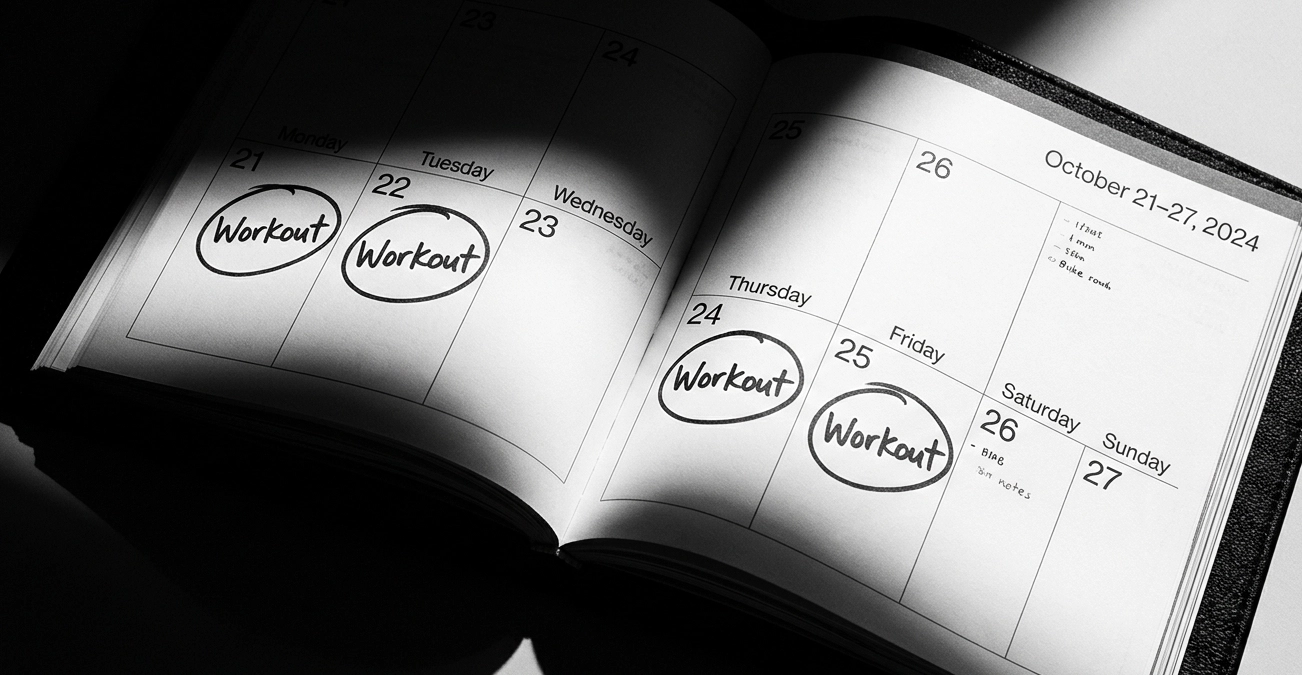 An upper/lower-style 4-day split is one of the cleanest entry points into split training.
The trade-offs, side by side
| Full body | Split | |
|---|---|---|
| Best for | 2–3 days/week | 4+ days/week |
| Frequency per muscle | High (2–3×/week) | Depends on the split (usually 1–2×/week) |
| Volume per session per muscle | Lower | Higher |
| Session length | Shorter, denser | Longer, more focused |
| Recovery demand | Spread out | Concentrated on specific muscles |
| Impact of a missed day | Small | Larger — especially on once-per-week splits |
Which one builds more muscle?
Honestly, when total weekly volume is matched, research and experience both point to very similar hypertrophy results between full body and split routines. You can build serious muscle on either one.
What actually moves the needle is:
- Total weekly volume per muscle group — roughly 10 to 20 hard sets per week for most lifters.
- Effort on each set — training reasonably close to failure on the working sets.
- Consistent progressive overload over weeks and months.
- Recovery — enough sleep, food, and time between sessions.
Pick the structure that lets you deliver those four things week after week. The “best” split is the one you actually run for six months, not the one that looks optimal on paper.
How to choose without overthinking it
Run through these questions in order:
- How many days per week can you realistically train for the next three months? Not your ideal, not your best week — your realistic average.
- If the answer is two or three, start with full body. Three full body sessions per week will out-produce almost any split you squeeze into the same number of days.
- If the answer is four or more and you’ve been lifting for a while, a split is a reasonable next step. Upper/lower is the cleanest entry point; push/pull/legs scales higher if you want six days.
- If you’re a beginner with four days available, you can still start with full body three days a week. The extra day is useful for recovery, cardio, or optional accessories — not a reason to jump to a split before you need one.
- When in doubt, pick the program you’re more likely to stick with. Adherence outperforms optimization every single time.
Common mistakes
A few patterns come up often when people switch between approaches.
- Jumping to a six-day split too early. More days don’t mean more progress if your recovery can’t keep up. If you’re not sleeping, eating, and showing up consistently, add those first.
- Running full body but treating each session like a split. If every full body day has ten exercises and takes two hours, you’ve built a split in disguise — and you’ll miss sessions to fatigue, not schedule.
- Changing programs every few weeks. Neither full body nor splits have time to show results if you never stay long enough to progress. Pick one and run it for at least 8 to 12 weeks.
- Ignoring your schedule. A program that requires six gym days will fail if you can only protect three. Build around your life, not around an ideal week you don’t actually have.
Making the choice easier to track
Whichever approach you pick, the day-to-day matters more than the label on the program. You need to know what you did last session, how much weight went up, and whether you’re progressing — without that feedback, any program turns into guesswork.
Steady is built for that part. It’s a distraction-free workout tracker that logs sets, reps, and weight fast, repeats your previous session with one tap, and shows your progress over time — without social feeds, subscription upsells, or hundreds of pre-built programs to sort through. Pick full body or a split, build it once in Steady, and let the app handle the tracking while you focus on the work.
Whichever one you pick, the best program is the one you can still run six months from now. Start there.
Ready to start applying progressive overload?
Ditch the spreadsheets and complex notes. Join thousands of lifters who use Steady to focus on the workout, track their progress, and automatically know when to add weight.
Download Free for iPhone